Mail and collaboration for government departments
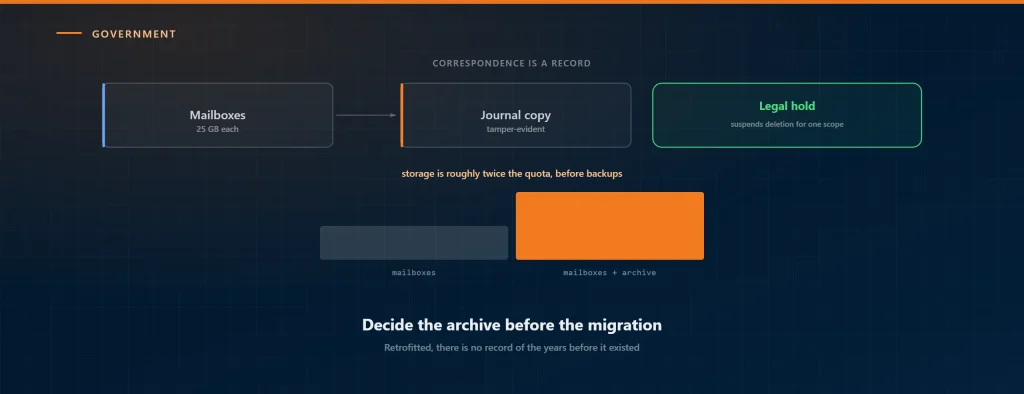
In a government department, mail is not only a communication tool. Official correspondence is a record, subject to retention rules and to disclosure requests, and that single fact changes the design more than the user count does.
Retention is the cost driver
The figure that surprises people is the doubling. Keeping a separate, tamper-evident copy of correspondence — a journal or compliance archive — is what makes retention and disclosure workable, and it means the platform holds roughly twice what the mailbox quotas imply, before backups.
The alternative, relying on users’ own mailboxes as the record, fails in the ordinary course of events: people delete things, mailboxes are closed when staff leave, and a request arriving two years later finds nothing. Decide the archive at the start; retrofitting it means you have no record of the period before it existed.
What the platform has to support
- Search across the archive by more than sender and date.A disclosure request describes a subject and a period. Answering it should not require a person to read mailboxes.
- Legal hold on an individual or a subject, which suspends deletion for that scope without suspending it for everyone.
- Departure that preserves the record.When an officer leaves, their correspondence remains a record even though the account should close. These are two different actions and the platform must allow them separately.
- Delegation with an audit trail.Assistants and duty officers routinely act on a mailbox; who sent what on whose behalf has to be recoverable.
Collaboration across departmental boundaries
The hard part is rarely within a department. It is the working group spanning three of them plus an external body, which today runs on personal accounts and file attachments because nothing else was available quickly.
Three decisions make the sanctioned route the easy one:
- Guest access with an expiry.External participants need access to one workspace for a defined period, and it should lapse without anyone remembering to revoke it.
- One copy of a document, not attachments.Attachments fork: five people edit five copies and the final version is whichever arrived last. A link to one document is the only mechanism that prevents it.
- A named owner per workspace.Shared spaces with no owner accumulate, nobody reviews their membership, and they become the least governed part of the estate.
The constraints to establish first
Before any platform is chosen: where data may be stored, whether the department’s own policy allows a shared-tenancy service, how identity federates with existing directories, and what must be provable about access. These decisions narrow the options substantially, and every one of them is more expensive to revisit after a migration than to settle before one.
Where this fits
The service is Mailing and Collaboration, and the sector context is Government. Retention and recoverability of the archive is Data Protection; citizen-facing telephony for the same departments is covered in IVR for government services.