Cloud advisory for IT and consulting firms
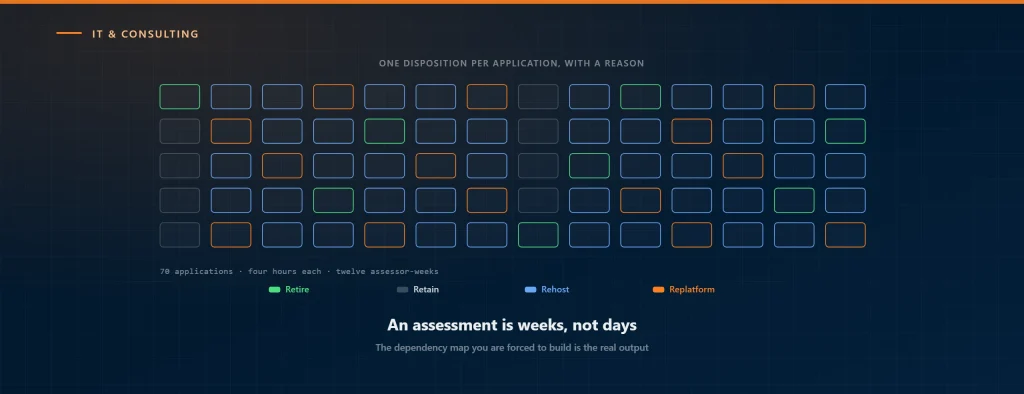
An assessment exists to answer one question: given this estate, this budget and these constraints, what should move, in what order, and what should not move at all. Everything else in the document is supporting material. Judged that way, most assessments are too long, too generic, and arrive too late to change the decision they were commissioned to inform.
Discovery takes as long as it takes
| Applications in the estate | One assessor | Two assessors | Four assessors |
|---|---|---|---|
| 40 | 4 weeks | 2 weeks | 1 week |
| 80 | 8 weeks | 4 weeks | 2 weeks |
| 120 | 12 weeks | 6 weeks | 3 weeks |
| 200 | 20 weeks | 10 weeks | 5 weeks |
Four hours per application — owner interview, dependency mapping, writing it up — against a 40-hour week. Simple applications take less and the three or four hardest take far more, so treat it as an average rather than a rate. The purpose of the figure is to set an expectation: an assessment of a mid-sized estate is weeks of work, and one delivered in days did not look at the applications.
The arithmetic matters because expectations are usually set before anyone has counted the applications. An estate of 120 applications is roughly twelve assessor-weeks of discovery; compressing that to a fortnight means either adding people or not looking at the applications. Both are legitimate choices, but only if made knowingly.
The expensive part is never the technical inspection. It is finding the person who knows why an application exists, what it connects to, and what breaks if it stops — and that person is usually busy, frequently in another department, and occasionally no longer employed.
What a useful assessment produces
- A disposition per application, with a reason. “Rehost” is a decision; “rehost because the vendor supports it, it has two dependencies and the owner has agreed a date” is an actionable one.
- A dependency map, from observation.Built from what actually talks to what, not from what the documentation claims. This is the artefact that survives longest and is most often missing.
- A sequence, with the first wave named.The first wave should be genuinely low-risk and genuinely visible, because its purpose is to build the operational habits and the organisational confidence the harder waves need.
- A cost model with its assumptions written down.A single number is not a model. What matters is which assumptions the number is sensitive to, so it can be revised rather than discarded when one turns out wrong.
- An explicit list of what is not moving, and why. Without it, the same three applications are re-argued at every steering meeting for a year.
What consulting firms specifically have to settle
Client data in your estate
A consultancy’s systems hold client material under obligations set by client contracts, not by its own policy. Those contracts frequently constrain where data may be processed and who may access it, and they differ per client. This needs establishing before an architecture, because it may rule out a shared environment for some clients entirely.
Project shapes, not steady state
Environments are created for an engagement and should disappear at the end of it. Where nothing enforces that, the estate accumulates environments for projects that finished years ago — still running, still costing, still holding client data. A lifecycle with an expiry is worth more here than in almost any other sector.
Practising what is being sold
Firms that advise on cloud are asked how they run their own. It is a fair question and the answer is used in buying decisions, which makes the internal programme a commercial asset rather than an overhead.
Where this fits
The service is Cloud Advisory Services, and the sector context is IT and Consulting. The design that follows an assessment is Cloud Architecture and Design, and the execution is migration.