OS and platform management for transport and logistics
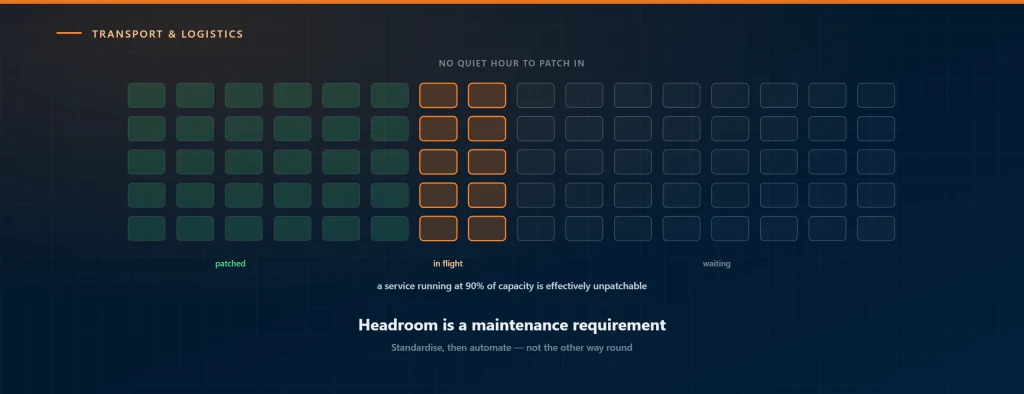
Logistics operations run continuously by design. Warehouses pick overnight, vehicles move through the night, and a customer portal that is down at 3am is down while somebody is trying to find their consignment. There is no quiet hour, which means maintenance either happens in flight or does not happen — and “does not happen” is how an estate ends up years behind on patching.
How long the estate is in a mixed state
The number that matters is not how long the patching takes but how long the estate spends half-patched, because that is the window in which two versions of the same service are live and any incompatibility between them is exposed. Taking more servers at once shortens the window, and how many you can take is decided by the spare capacity designed into the system — a service running at 90% of capacity can spare almost nothing and is therefore effectively unpatchable.
That is worth saying plainly: capacity headroom is a maintenance requirement, not only a performance one. An estate sized with none cannot be maintained without an outage.
Standardise before automating
Automation applied to an estate where every server is slightly different produces a different failure on each one. The order that works is: inventory, then standardise, then automate.
- Inventory that is generated, not maintained.A list somebody updates by hand is wrong within a month. See the asset register nobody maintains for what to do instead.
- A small number of supported builds.Three operating system versions with a known configuration is an estate you can patch. Thirty variants assembled over a decade is one you can only patch by hand.
- Configuration as code.The point is not elegance — it is that a rebuilt server is identical to the one it replaced, which is what makes replacing one a routine act rather than a project.
- A rollback that has been used.A patch that cannot be backed out during a night shift is a patch nobody will apply.
What is specific to this sector
The edge is most of the estate
Handheld scanners, label printers, yard terminals and vehicle devices outnumber the servers, sit on poor connections, and are frequently powered off when you want to reach them. Updates for these need to be resumable and to survive a device that disappears mid-transfer.
Integration partners set your compatibility
Carriers, customs systems, port and customer platforms all have their own upgrade schedules, and you inherit them. A platform upgrade that breaks an EDI connection to a carrier is not an internal problem, and these dependencies belong in the change process rather than being discovered by it.
Peak seasons freeze everything
Most logistics businesses impose a change freeze over their peak. That concentrates a year’s maintenance into the remaining months and makes the calendar, not the risk assessment, the real constraint. Plan the year backwards from the freeze.
Where this fits
The service is OS and Platform, and the sector context is Transport. Running it as a managed function is Infrastructure Managed Services; the underlying problem is worked through in patching without a maintenance window you cannot get.