Interactive voice response for government services
A government helpline differs from a commercial one in a way that changes the design: the caller usually has no alternative. They cannot take their business elsewhere, they may have no internet access, and they may be calling about something with a deadline attached. An IVR that filters callers out is not reducing demand — it is failing the people the line exists for.
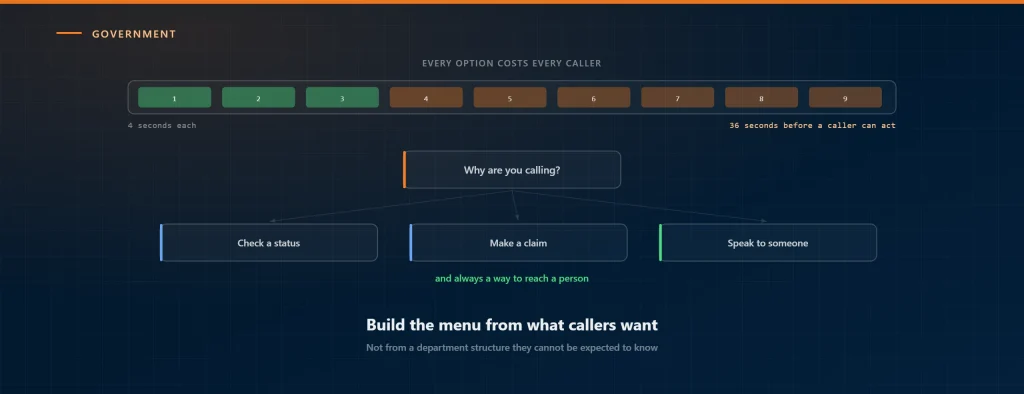
Every option costs every caller
Nine options is over half a minute of listening before anyone can act, and by the end of it most callers cannot remember what option two was. The usual cause is organisational: the menu mirrors the department structure, so every team gets an option, and the caller is asked to know which team handles their problem. They do not — that is why they are calling.
Build the menu from what callers want to do, in the order they want it, and put the most common reason first. Three or four options at the top level handles most volume. Anything rarer goes behind the option it most resembles, or to a person.
What a citizen-facing line has to get right
Language, chosen once and remembered
Language selection belongs at the very start, before anything else is said, and the choice has to carry through the whole call including the hold messages and the agent it reaches. A caller who selects Hindi and then hears English options has effectively been dropped.
A way to reach a person
Always, and stated. Not hidden behind pressing nothing three times. Some callers cannot use a keypad menu — a rotary line, a disability, a poor connection — and for a public service that is not an edge case to be tolerated but a duty to be met.
Honest waiting
A stated position in the queue or expected wait lets the caller decide whether to hold. Silence, or a loop claiming the call is important, converts a wait into a grievance. A callback that holds the caller’s place is better still where volumes justify it.
Saying what the line cannot do
If a service is closed, a deadline has passed, or the enquiry needs a different number, say so in the first fifteen seconds rather than after four minutes of queueing. Nothing produces more anger than a long wait ending in “you need to call a different department”.
The parts that repay automation
Not everything should reach a person, and the honest test is whether the answer depends on judgement. Status checks, deadlines, office locations and hours, application progress against a reference number — these are lookups, they are the bulk of many public helplines, and they are answered faster by the system than by a queue. Anything involving eligibility, an appeal, a hardship or a dispute is judgement, and belongs with someone who can exercise it.
What to review
- Abandonment by menu position.A node people leave from is a node that is confusing, not a node nobody needs.
- Zero-out rate.A high proportion pressing straight through to an operator means the menu is not answering the question.
- Repeat callers within a week.The measure of whether the first call resolved anything, and the one most worth acting on. The same argument is made in full in first contact resolution is the only queue metric worth a target.
Where this fits
The product is AcmaIVR, and the sector context is Government. Where the line is staffed as a contact centre, that is AcmaTel CCS; for outbound notification of deadlines and appointments, AcmaOBD.