Lead management for education and e-learning
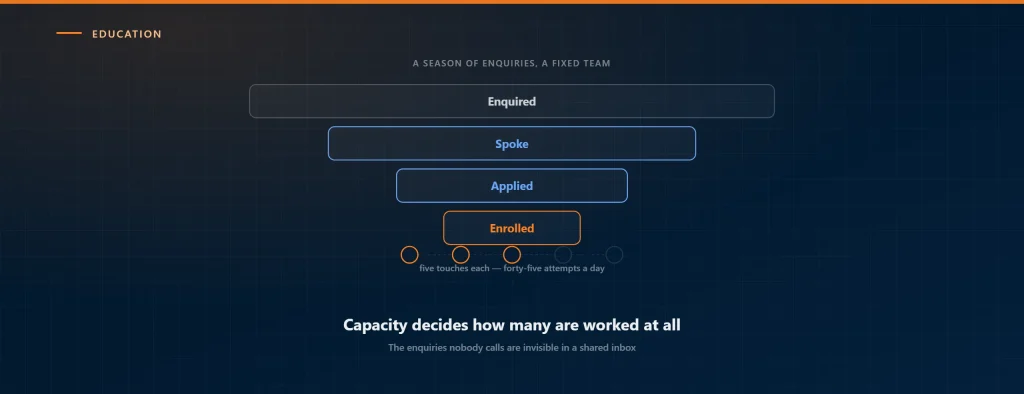
Admissions has a shape almost no other sales function has: the enquiries arrive in a compressed season, against a deadline that does not move, and are handled by a team whose size was fixed months earlier. Enquiries do not go cold gradually here. They go cold because a date passed.
The arithmetic nobody does before the season
Set that against a real intake. An institution taking 300 enquiries a week during the peak, with four counsellors and a five-touch follow-up policy, has capacity for about 180. The other 120 are not lost to competition — they are never worked at all, and nobody can name them afterwards because the shortfall is invisible in a shared inbox.
There are only three honest responses: more counsellors, fewer touches, or deciding in advance which enquiries get the full sequence. The third is almost always right, and it needs the enquiry to carry enough information to make the decision. Which is the actual argument for a lead system: not storage, but triage.
What has to be recorded for follow-up to survive
- Source, at the level you can act on.Not “digital” but the specific campaign, page or event. Source is what tells you where next season’s budget goes, and it is unrecoverable after the fact.
- Programme of interest.An enquiry without it cannot be routed to someone who can answer, and gets a generic reply that answers nothing.
- Every attempt, including the failed ones.Three unanswered calls is information. An empty history looks identical to an enquiry nobody has touched, and the counsellor who picks it up starts again from the top.
- The next action and its date.The single field that most determines whether a sequence completes. Without it, follow-up depends on someone remembering.
- Stage, on a scale that means something.Enquired, spoke, applied, paid. Four stages people use beats twelve nobody updates.
The parts specific to education
The influencer is not always the applicant
For school and undergraduate admissions the parent is frequently the decision-maker and often the contact. A record holding one name and one number loses the conversation the moment the other person calls.
Enquiries arrive out of hours
Evenings and weekends are when families research. An enquiry landing at 9pm that gets its first response at 11am on Monday has spent the entire window in which it was easiest to reach someone waiting. An automatic acknowledgement that sets an expectation costs nothing and holds the position.
The same person enquires more than once
Across two programmes, a webinar and an open day, one family becomes four records, gets four different counsellors and four different answers. Deduplication on phone number and email is not tidy-mindedness — it is the difference between one conversation and four contradictory ones.
What to review after the cycle
Three numbers, and they are worth more than a dashboard of twenty:
- Enquiries never contacted.The capacity gap above, measured rather than estimated. If it is large, the follow-up policy is fiction.
- Time to first response, by hour of arrival. This is where an out-of-hours problem shows up as a number.
- Applications by source.Not enquiries by source — applications. The two rank differently often enough that spending on the first is how budget goes to the channel producing the most noise.
Where this fits
The product is AcmaLMS, and the sector context is Education and E-Learning. Where enquiries arrive by phone, the routing and recording side is AcmaTel CCS; the same capacity question in a contact centre is worked through in occupancy, shrinkage and the arithmetic behind staffing.