Measuring an augmented team without measuring the wrong thing
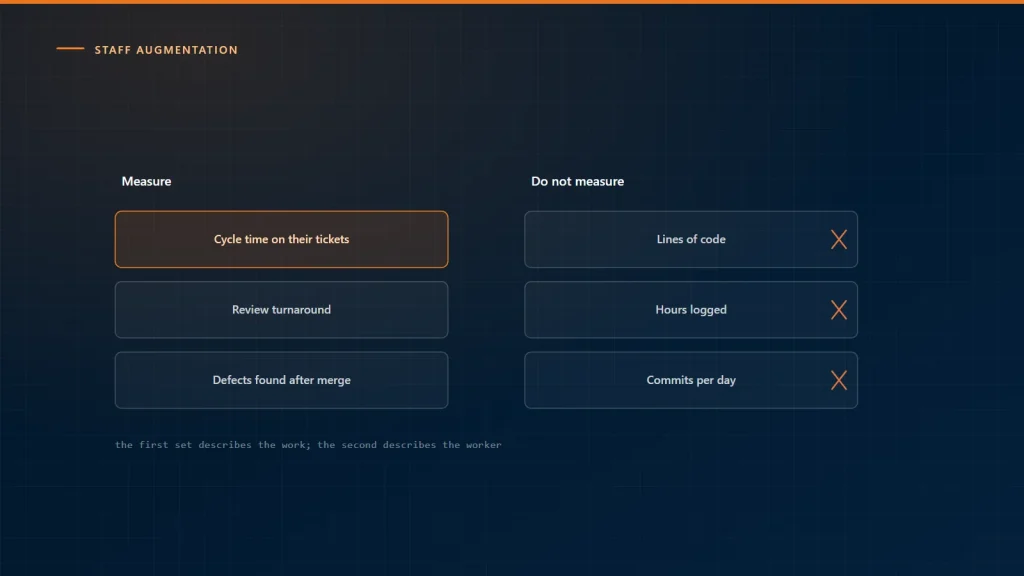
When part of the team is invoiced, there is a pull toward measuring them differently from everyone else — usually by hours, sometimes by output volume. Both are easy to collect and both measure the wrong thing, and measuring augmented people differently creates the two-tier dynamic that makes augmentation fail.
What hours actually tell you
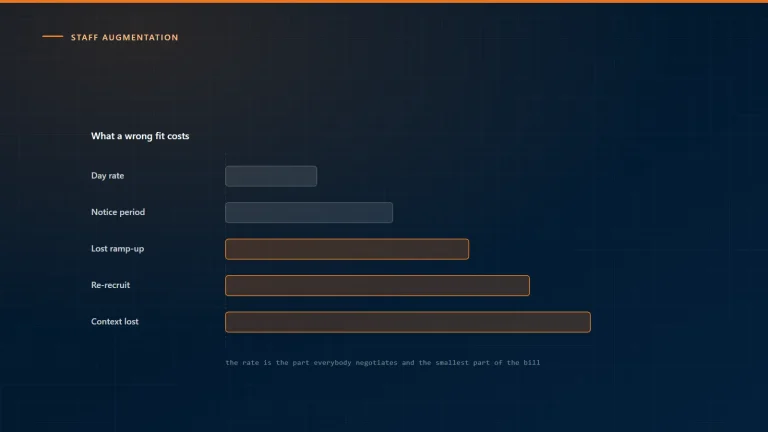
Hours are an input. They tell you what you are being charged and nothing about what you received. A team billing full weeks while the release slips is possible, common, and entirely consistent with everyone working hard on the wrong things.
Track hours for budget. Do not read them as performance. And be wary of the impulse to scrutinize timesheets when delivery feels slow — it converts a delivery conversation into an accounting one, and the delivery problem is still there afterwards.
Why volume metrics are worse
Lines of code, commits, tickets closed: all of them reward the wrong behavior, and they reward it faster in a team that knows it is being compared to permanent staff. Tickets closed encourages splitting tickets. Commits encourage small commits. Lines of code encourages the opposite of good engineering.
The deeper problem is that the best contributions frequently show as low volume — the change that deletes code, the design conversation that avoids three weeks of work, the investigation that finds the real cause.
Measure the team, not the individuals
The unit of delivery is the team. If augmented engineers are integrated properly they are part of it, and the same measures apply to everyone:
- Cycle timeFrom work starting to being in production. It captures review delays, environment problems and handoffs, which are where most delay actually lives.
- Deployment frequencyHow often the team ships. A proxy for how much friction is in the path.
- Change failure rateHow often a change causes a problem. The counterweight that stops speed being gamed.
- Time to restoreHow quickly problems get fixed.
These are the DORA measures, they are well understood, and their virtue here is that they cannot be moved by one person working longer hours. They move when the system gets better.
The things worth watching specifically on an augmented engagement
A few signals are genuinely specific to this model, and none of them are productivity measures:
- Review participation in both directions.If augmented engineers’ work is reviewed by permanent staff but never the reverse, they are not in the team — they are a supplier inside it, and knowledge is only flowing one way.
- Bus factor by area.If a system is understood only by someone whose contract ends in March, that is a scheduled outage. This is the most important thing on the list.
- Question volume over time.It should fall in the first month and then plateau. A flat line from the start usually means someone is stuck and not asking.
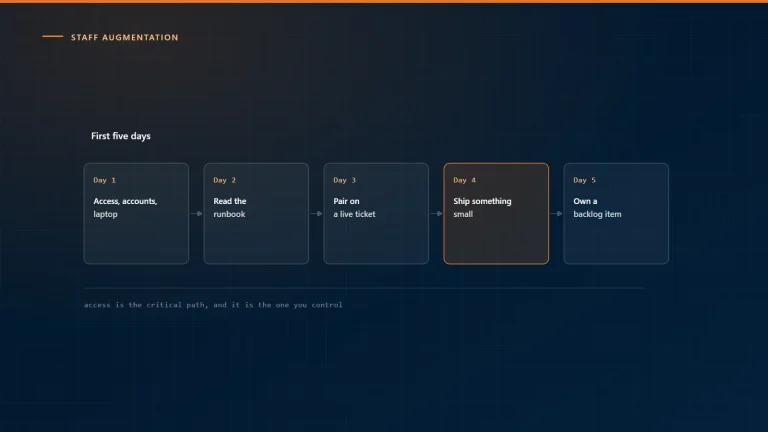
- Time to first merged change.Measured per new person, it tells you about your onboarding rather than about them, and it is directly actionable.
Reviews that are worth holding
A monthly conversation with the provider that covers what shipped, what is blocked, what is at risk and what changed in the plan. Half an hour, against the same delivery view the internal team uses.
What makes it useful is that it is about the work rather than about the people. If a specific individual is not working out, that is a direct conversation and it should happen immediately rather than being saved for a review.
The honest summary
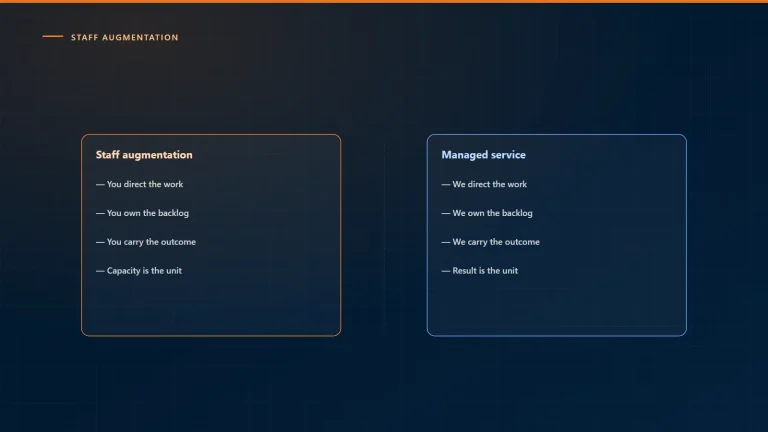
Measure augmented people exactly as you measure your own — by what the team delivers and how reliably. Track hours for the budget. Watch knowledge concentration, because it is the one risk that is genuinely worse in this model and the one that is invisible until the contract ends.
Our staff augmentation engagements assume our engineers are measured inside your delivery process rather than beside it, and that knowledge transfer is part of the work rather than an event at the end. Tell us what your delivery view looks like and we will work to it.