Staff augmentation or a managed service? The question that decides it
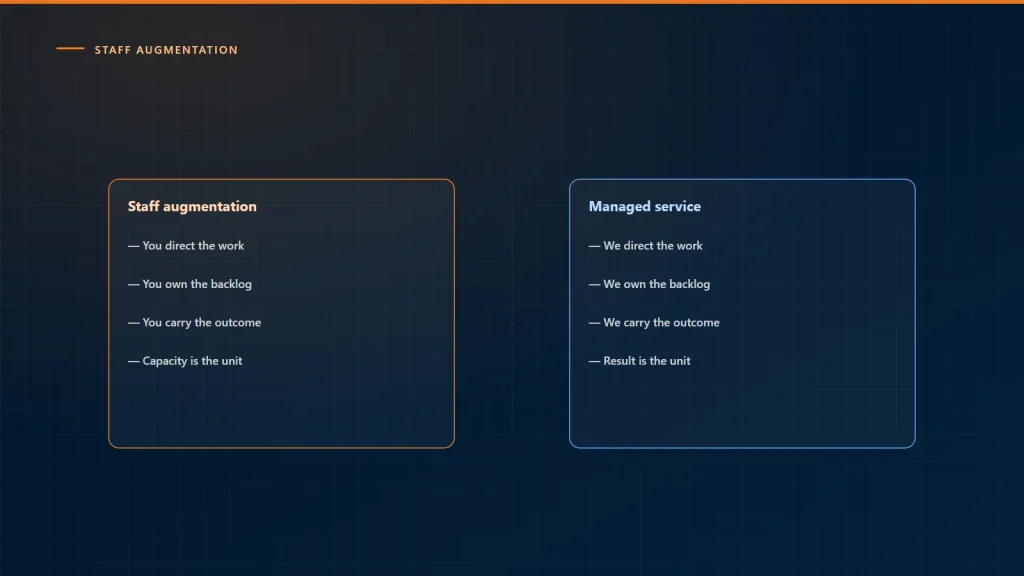
Staff augmentation and managed services are usually presented as points on a scale, cheaper and more flexible at one end, more complete and more expensive at the other. They are not on the same scale. They answer a different question, and the question is: who is accountable for the result?
The distinction in one line
With augmentation, you direct the work. The people join your team, your standards and your process; you decide what gets built and in what order; you own whether it worked.
With a managed service, the provider directs the work. You define the outcome and the standard; they decide the staffing, the method and the rota; they own whether it worked.
Everything else — rates, contract length, notice periods, where people sit — follows from that, and none of it resolves a wrong choice.
When augmentation is the right model
- You know exactly what you want built.You need more hands to build it: the specification is not the constraint, capacity is.
- The work is entangled with your own context.Your codebase, your domain, your decisions. Separating it into a deliverable someone else owns would cost more than doing it.
- The requirement is genuinely temporaryA migration, a release, a parental leave, a spike you can see the end of.
- You have management capacity.This is the one people skip. Augmented engineers need direction from someone with time to give it.
When a managed service is the right model
- The outcome is definable and the method is not interesting to you.Servers patched, queues answered, backups tested — you care that it is done to a standard, not how it is staffed.
- It is continuous, not a project.Anything that needs covering every day, indefinitely, is a poor fit for augmentation because it needs a rota, and a rota is a management job.
- You want the coverage problem to be somebody else’s.Holiday, sickness and attrition are the provider’s to solve.
- You do not have the in-house expertise to direct the work.Augmentation would give you people you cannot usefully manage.
The failure mode in each direction
Augmentation bought as an outcome
The customer expects a delivered result; the contract supplies hours and hands. Nobody is planning, nobody is deciding priorities, and the work drifts. When it is late, both sides are correct in their own terms: the provider supplied what was agreed, and the customer did not get what they wanted. This is the more common of the two, and it is nearly always visible in the contract months before it becomes a dispute.
A managed service bought as hands
The customer wants to direct individuals and finds they cannot — the provider staffs to the service level, rotates people, and treats the named person as an implementation detail. The customer experiences this as lack of ownership when it is exactly what they contracted for.
The test that settles it
Ask: if this goes wrong, whose fault is it?
If the honest answer is “ours, because we set the direction” — augment. If it is “theirs, because they agreed to a standard and missed it” — buy a service. If the answer is unclear, the contract is going to be unclear too, and that is worth fixing before signing rather than after.
Mixing them deliberately
Most organizations end up with both, and that is fine when the boundary is drawn by system rather than by task. The infrastructure is a managed service; the product team is augmented. Trouble comes from splitting a single piece of work across the two models, because then accountability genuinely is shared, which means it is held by nobody.
Cost is not the deciding factor
An hourly comparison usually favours augmentation, and it usually leaves out the management time, the recruitment cycle, the coverage gaps and the knowledge that leaves when the contract ends. A managed service has those costs inside the price. Neither is cheaper in general; they are cheaper for different shapes of work.
We offer both — staff augmentation where you own the direction, and managed services where we own the standard. If you are unsure which your requirement actually is, describing the work is usually enough to tell.