Knowledge transfer: what to do before the contract ends
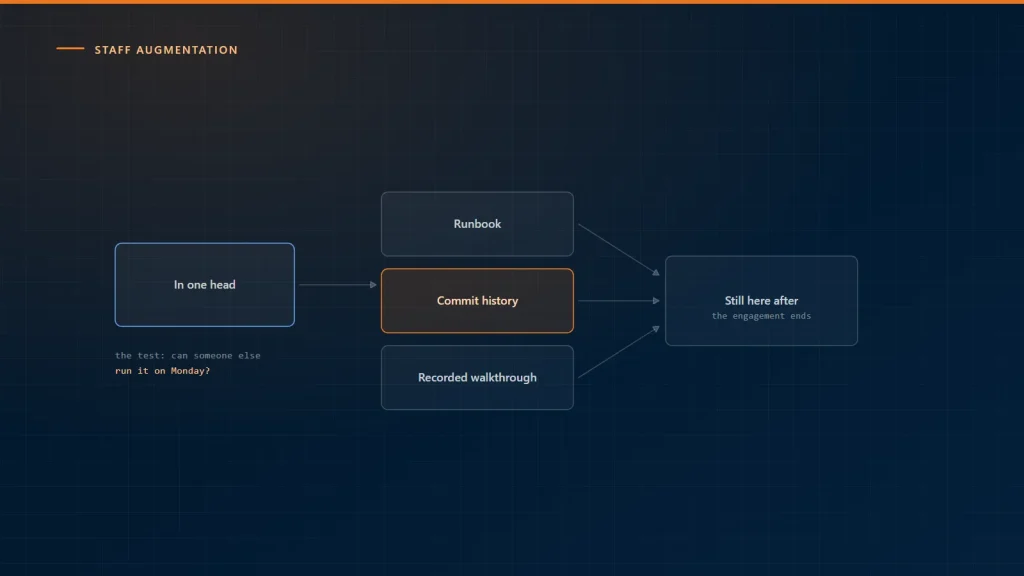
The standard plan for knowledge transfer is a week of handover at the end: some documentation, a few walkthroughs, a recorded session. It reliably fails, and it fails for a structural reason — you cannot transfer in a week what took months to acquire, and the recipient has no context to attach it to.
Transfer happens during, or it does not happen
The things that actually move knowledge are ordinary working practices, applied from the start:
- Reviews in both directions.Permanent staff review augmented engineers’ work, and the reverse. Reading someone’s code is how you learn what they know; reviewing it is how you find out what you do not.
- Pairing on the hard parts.Not everything, but the complicated and the unfamiliar. An hour of pairing transfers more than a day of documentation, because the questions arrive in context.
- Rotating who handles what.If one person has taken every incident on a system for six months, they hold its knowledge alone, whether or not they are on your payroll.
- Decisions written down when made.A short record of what was decided and why, at the time. Reconstructing that at the end produces a plausible story rather than the actual reasoning.
Watch where knowledge is concentrating
The risk is not that contractors know things. It is that they are the only ones who know things, and that state arrives gradually without anyone deciding it.
Every month, look at each significant system and ask how many people could handle a serious problem in it at three in the morning. Where the answer is one, and that one has an end date, that is the item to act on — by pairing, by rotating, or by moving work deliberately to someone else.
This check takes ten minutes and it is the single most useful thing on this page.
What the last month should contain
If the engagement has been run as above, the final month is confirmation rather than transfer:
- Stop assigning new work in areas only they know. Assign it to whoever is taking it over, with them reviewing.
- Have the receiving person handle incidents in those areas, with the leaver available but not acting.
- Walk the operational realities — the deployment that needs a particular order, the job that fails on the first of the month, the customer with the unusual configuration. This is the knowledge that is never written down anywhere.
- Fix the documentation against reality, with the person taking over doing the writing. If they can write it, they understood it; if they cannot, you have found the gap while there is still time.
- Do a dry run. Someone else does a release, a restore, a routine change, unaided.
Documentation that is worth writing
Most end-of-engagement documentation is an inventory of what exists, which the code already provides. What is worth writing is what the code cannot say:
- Why it is built this way, and what was tried and rejected.
- What breaks, how it presents, and what fixes it.
- Who to contact outside the team — which supplier, which internal department, which specific person.
- What is deliberately unfinished, and what the plan was.
- Anything that looks wrong but is intentional. This one prevents the most damage.
Access and accounts
Not knowledge transfer, but it belongs in the same checklist because it is forgotten at the same moment: every account, key, certificate and integration created during the engagement, listed and either transferred or revoked. Scheduled jobs and API credentials running under a personal account are the classic finding, usually discovered when they stop.
The short version
Knowledge transfer is a property of how the engagement was run, not an event at its end. Review in both directions, pair on the difficult things, rotate the operational work, write decisions down as they are made, and check monthly where knowledge is concentrating. Do that and the handover is a formality. Skip it and no amount of final-week documentation will cover the gap.
Our staff augmentation engagements treat this as part of the work rather than a closing task, because an engagement that leaves a hole behind it has not finished well regardless of what it delivered.