Vehicle repossession for lenders and NBFCs
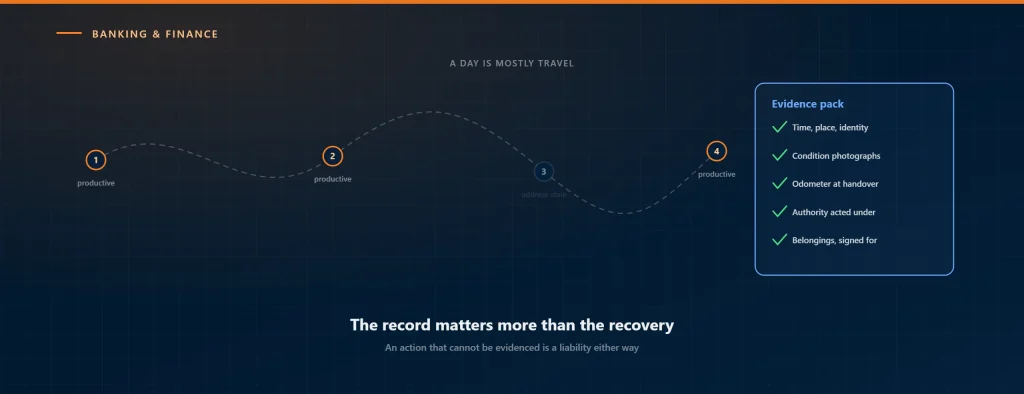
Recovery operations are limited by geography rather than effort. An agent’s day is mostly travel, and the difference between a well-sequenced round and a list handed out in account order is several visits a day per agent — which is the whole productivity question in this function.
What a day actually holds
Two consequences worth planning around. Allocating work by account number rather than by geography can halve an agent’s output, and it is the most common way it is allocated. And because a meaningful share of visits close nothing, the capacity that matters is productive visits, not visits — which means the address quality and the timing of the visit deserve as much attention as the routing.
The record matters more than the recovery
Repossession is a regulated activity, and an action that cannot be evidenced afterwards is a liability regardless of whether it was correct at the time. The field application’s first job is therefore not routing. It is producing a record that stands up later.
- Time, place and identity, captured automatically.Written afterwards from memory, these are worth very little; captured at the point of the visit, they are the whole defence.
- Photographs at handover, of condition and of the odometer.Disputes about damage are common and unresolvable without them.
- The authority the agent acted under, attached to the case — the notice served, the account status at that moment, the mandate.
- Inventory of belongings.Personal property in a recovered vehicle is the most frequent source of complaint and the easiest to prevent with a signed list.
- Refusals and aborts, recorded as outcomes.An agent who withdrew when they should have is behaving correctly, and that is only visible if there is somewhere to record it.
Capture on the device rather than on paper matters for a reason beyond convenience: the record is timestamped where the event happened rather than reconstructed at the office that evening.
Where cases actually stall
Address quality
Data captured at origination and never verified sends agents to addresses people left years ago. Cases failing repeatedly at the same address are a data problem that field capacity cannot solve, and they should be routed to tracing rather than retried.
The account moving underneath the case
A customer who paid or agreed a settlement this morning must not receive a visit this afternoon. The connection between the collections system and the field application has to be live, and the consequence of a lag is the incident nobody wants.
Post-recovery drift
Between recovery and disposal a vehicle sits in a yard depreciating. This part of the process is often outside the system entirely, and it is where recovered value is quietly lost.
What to track
- Productive visits as a share of visits attempted, by agent and by area. Persistent differences are usually data quality, not performance.
- Days from allocation to recovery, and separately days from recovery to disposal. The second is frequently the longer one.
- Cases with an incomplete evidence pack.Reviewed weekly while it is still possible to fix.
Where this fits
The product is RepoAPP, and the sector context is Banking and Finance. The collections contact that precedes field allocation runs on AcmaTel CCS; where the underlying systems are being moved, see cloud migration for banking.