Storage for media and entertainment production
Storage planning in production is unusual in one respect: the size of the problem is known in advance and almost never calculated. Frame rate, codec, camera count and shoot length give you the number before anything is shot, and the number is usually larger than the assumption behind the purchase order.
Start from the arithmetic, not the shelf
The spread is the whole point. An hour of delivery-grade H.264 and an hour of uncompressed 1080p differ by more than a hundred times, and both are “an hour of video” in a planning conversation. Three cameras shooting eight hours a day in ProRes 422 HQ produce around 2.4 TB a day before a single edit exists; the same schedule at 4K produces nearly 9.5 TB.
Do this calculation per project rather than per year. Annual figures average away the peak, and the peak is what fills the array.
Tiers, and why the fastest one is the wrong default
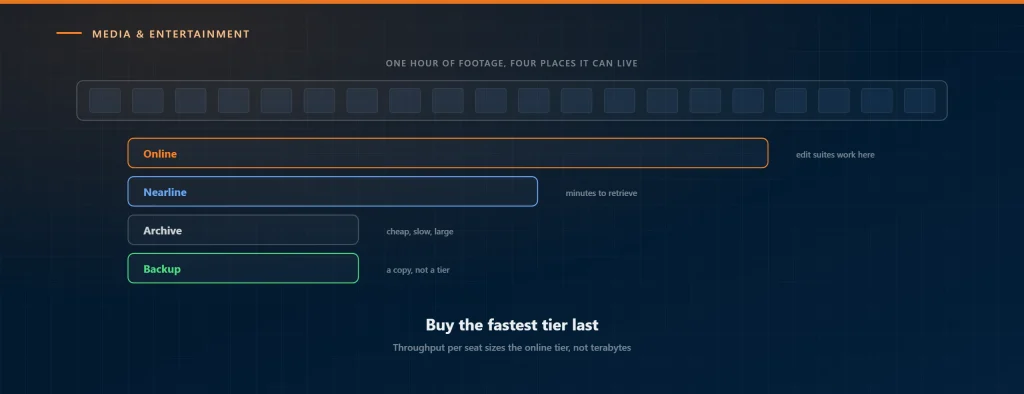
Media estates divide cleanly into four tiers, and the mistake is buying the first one for all of it.
- Online.Fast shared storage the edit suites work from directly. Sized for the projects in flight, not the library. This tier is expensive per terabyte and should stay small.
- Nearline.Recently finished projects, retrievable in minutes. Most of what people believe must be online belongs here.
- Archive.Finished work kept for its long life. Cheap per terabyte, slow to retrieve, and entirely adequate for material nobody has opened in a year.
- Backup.Not a tier — a second copy of whatever is in the ones above. Archive is where something lives; backup is protection against losing it. Treating an archive as a backup means a deletion propagates.
The rule that decides placement is access frequency, and it is worth measuring rather than guessing. Editors will say everything must be online; the file access times usually say otherwise.
Throughput is the requirement, not capacity
An array large enough to hold the project can still be too slow to edit from. The number that matters for online storage is sustained throughput to concurrent seats: an editor scrubbing ProRes 422 HQ 4K needs roughly 110 MB/s to themselves, so six seats working simultaneously need around 660 MB/s sustained, before any background transcode or ingest competes for the same spindles. Specify shared storage by that figure and by the number of seats, not by terabytes.
Before anything is archived
- Verify the copy, do not trust it.Checksum on write and again on read. Silent corruption is the failure mode archives actually suffer, and it is invisible until the restore.
- Archive the project, not the files.Media without its project file, effects settings and fonts is footage, not a restorable edit.
- Record the format.A codec that needed a specific plugin will need it again in eight years. Note it with the archive.
- Retrieve one at random, annually.The same discipline as testing a restore: an archive nobody has read from is a hypothesis.
Where this fits
The service is Storage Solutions, and the sector context is Media and Entertainment. Protection of the archive is Data Protection; where the shared storage is consolidated with compute and networking, see Hyperconverged Infrastructure.