Hospital management for super-speciality hospitals
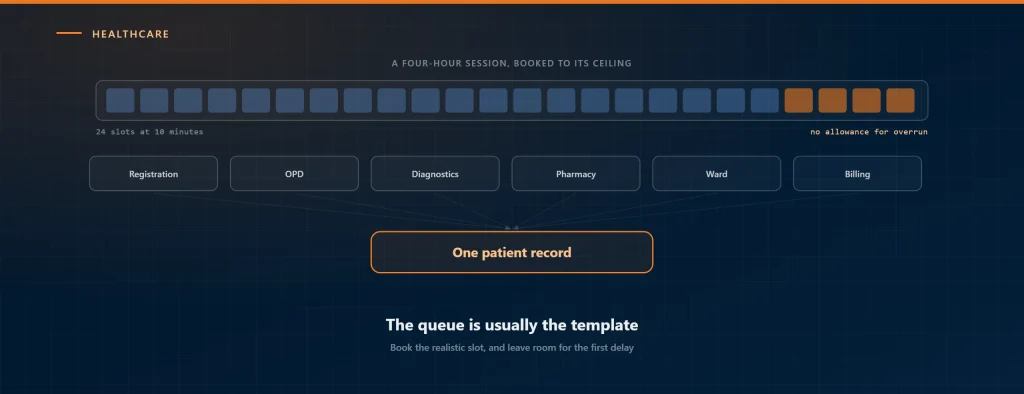
Ask why an OPD runs two hours behind and the answer offered is usually volume. It is more often the template: a clinic booked to its theoretical ceiling has no capacity to absorb the first delay, so every subsequent patient inherits it and the queue grows through the session.
Slot arithmetic, and the allowance nobody makes
The figures are ceilings with nothing held back. A consultant who needs two minutes between patients to finish notes is not doing ten-minute consultations — they are doing twelve, and a session booked at ten is overbooked by 20% before it starts. Neither is the mix constant: a new-patient clinic and a review clinic are different templates and should not share one.
Two changes fix most of it, and neither needs more consultants. Book the realistic slot length rather than the target one. And leave a small number of slots unbooked mid-session, so the first overrun is absorbed instead of compounding.
What a hospital system has to join up
Super-speciality hospitals rarely lack systems. They lack one record. The registration desk, OPD, diagnostics, pharmacy, wards, theatres and billing each hold part of a patient’s episode, and where they do not share an identifier, staff move information between them by hand — which is slow, and is where errors enter.
- One patient identity, resolved at registration.Duplicate records are the root cause of a surprising share of clinical and billing problems, and they are far cheaper to prevent at the desk than to merge afterwards.
- Orders and results in the same place as the notes.A result the consultant has to go and look for in another system is a result that gets chased by phone.
- Billing that accrues as care is given.Assembled at discharge from paper, it delays the discharge and loses charges. Accrued as it happens, discharge is a review rather than a reconstruction.
- Pharmacy and stock against the prescription, so availability is known when the drug is prescribed rather than when the patient reaches the counter.
Discharge is a process, not an event
Discharge delay occupies beds that are needed and is nearly always caused by waiting — for a summary, a final bill, a pharmacy dispense, a transport arrangement. Because each wait sits with a different department, nobody sees the whole delay and it is reported as a bed shortage. Making the steps visible as a single sequence, with a name against each, is usually the cheapest capacity the hospital can buy.
What to measure
- Waiting time from appointment to consultation, by session rather than averaged across the week. Averages hide the two clinics causing the complaints.
- Session overrun.Measured against the template, it tells you whether the template or the volume is wrong.
- Time from discharge decision to bed free.The number that converts directly into admissions capacity.
- Duplicate patient records created per month.A data-quality measure with clinical consequences.
Where this fits
The product is AcmaCare, and the sector context is Healthcare. Tiering the modules for recovery is covered in disaster recovery for hospitals; for an individual consultant’s own case records rather than a whole hospital, see ConsultPro.