Case management for Ayurveda clinics
Most clinical record systems assume an episode is a visit. Ayurveda usually does not work that way: a consultation leads to a course of treatment running daily or several times a week for weeks, with the plan adjusted as it goes. A record built around single visits records the sessions and loses the thing that matters, which is the course.
Capacity is a room problem before it is a demand problem
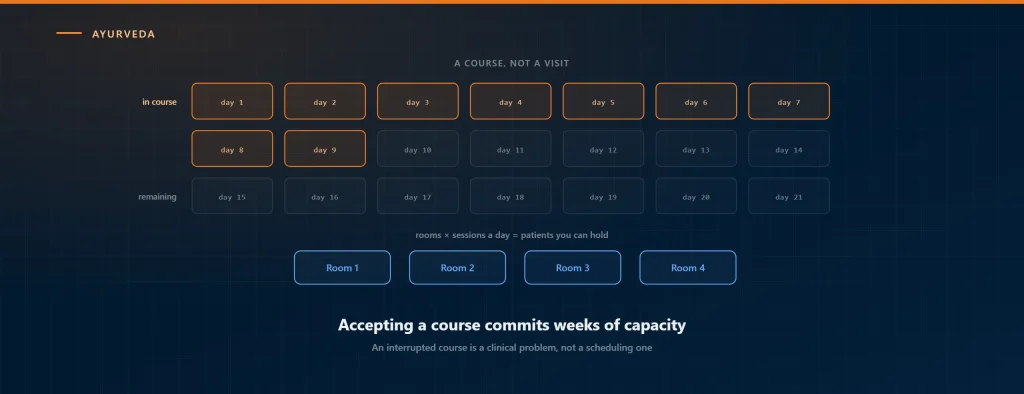
The number that constrains an Ayurveda clinic is rarely consultation slots. It is therapy rooms multiplied by the length of a session, and because a patient in course consumes a session every day for weeks, the clinic fills in a way an outpatient clinic does not: accepting one new course commits capacity for its whole duration.
Which means intake has to be planned against the course calendar rather than against today. A clinic that books new courses on the basis of today’s free rooms discovers in week two that it cannot deliver the ones already started — and an interrupted course is a clinical problem, not a scheduling inconvenience.
What the record has to hold
- The course as an object, not a series of visits.Its plan, its intended duration, which session the patient is on, and what remains. Without it, nobody can answer “how far through is this patient” without counting.
- Assessment at intake, in a form that can be compared later.The value of a structured intake is that week six can be set against week one; free text cannot be compared with itself.
- What was actually done each session, and by whom.Therapists change through a course, and the next one needs to know what the last one did and how the patient responded.
- Preparations dispensed, with quantity and batch.Where the clinic makes or dispenses its own, this is both a clinical record and a stock record, and keeping it in two places guarantees they disagree.
- Deviations.A missed session, a shortened one, a step skipped. These explain outcomes and are the first thing lost when records are kept as a tick sheet.
The consultant working across locations
Practitioners commonly consult at more than one clinic, and each keeps its own records. The patient’s history then depends on which building they are standing in. For a course of treatment reviewed at intervals, that is the difference between an informed adjustment and a guess — and it is the strongest practical argument for the case record following the consultant rather than sitting with the premises.
Follow-up after the course ends
Most of the clinical value of a course shows up after it finishes, and most clinics have no mechanism to look. A scheduled review at a fixed interval — recorded as part of the course rather than left to the patient to arrange — is the only reliable way a clinic learns whether what it does works, and it is also the point at which continuing care is most naturally discussed.
What to review
- Courses completed against courses started.The clearest signal a clinic has, and one that a visit-based record cannot produce.
- Room utilisation against the capacity above.Persistently below it usually means the booking template, not demand.
- Reviews scheduled and attended after completion.Low numbers here mean outcomes are not being observed at all.
Where this fits
The product is ConsultPro, and the sector context is Ayurveda. Where the practice is part of a larger hospital with wards, diagnostics and billing, that is AcmaCare; appointment reminders by voice are AcmaOBD.