Cloud architecture for tour and travel platforms
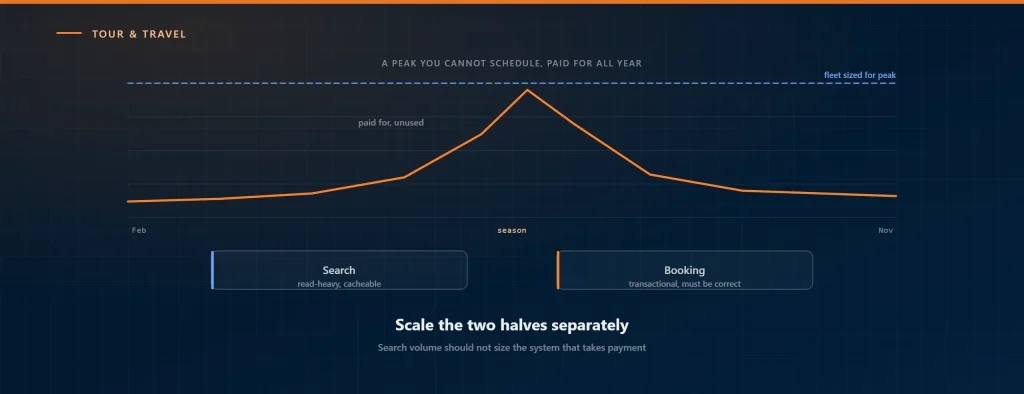
Travel platforms have a traffic shape that punishes fixed capacity. Demand concentrates into holiday periods, fare drops and campaign windows, and the gap between a quiet Tuesday in February and the first weekend of a sale is not a percentage — it is a multiple.
What sizing for the peak actually costs
The table is the argument for elasticity, stated plainly. At a six-fold seasonal peak, a fleet sized to survive the season sits 83% idle on average across the year. That is not an efficiency footnote; for most travel businesses it is the largest line in the infrastructure budget.
Two cautions before treating autoscaling as the answer. Scaling takes time, and a fare drop does not arrive gradually — if instances take four minutes to become useful, the first four minutes of the spike hit whatever is already running. And scaling the application tier is easy in a way that scaling the database is not, so the database usually becomes the limit the moment everything else stops being one.
Search and booking are different systems
This is the design decision that matters most in travel, and the one most often missed. Search is read-heavy, tolerant of slightly stale data, and enormous in volume: most sessions search repeatedly and book nothing. Booking is transactional, must be correct, and is a small fraction of the traffic.
Separating them lets you cache search aggressively and scale it independently, while keeping the booking path conservative and consistent. Run together, search volume sets the size of the system that takes payments, and a search spike can take bookings down — the one part of the platform that earns.
Designing around suppliers you do not control
A travel platform is an aggregator of other people’s systems: airline and hotel inventory, payment gateways, channel managers. All of them will be slow or unavailable at some point, and none of them will tell you first.
- Timeouts on every call, set deliberately.The default in most HTTP clients is far too long, and a supplier that hangs will hold your threads until the platform stops responding.
- A circuit breaker per supplier.Stop calling one that is failing, serve what you can from cache, and say so — rather than making every customer wait for the same timeout.
- Degrade rather than fail.Results from four working suppliers are a usable page. An error page because a fifth is down is not.
- Cache with an explicit staleness policy.Price and availability age quickly, but serving a five-minute-old fare with a re-check at booking beats serving nothing.
Test before the season, not during it
Load testing is worth doing once a year, against the real architecture, at the multiple you expect and then one step beyond. Its value is not the pass mark — it is finding which component gives way first, which is almost never the one the team predicts. Do it early enough that the answer can change the design.
Where this fits
The service is Cloud Architecture and Design, and the sector context is Tour and Travel. Where the platform is being built rather than re-shaped, see Cloud-Native Applications; running it through a season is Cloud Managed Services.