Innovative Solutions for Modernizing Government Sector

Government technology is usually discussed in terms of modernization programs. The more useful frame is narrower: most citizen-facing services fail at one of three points, and they are the same three points in almost every department.
One: the service is reachable only one way
A service available solely through a web portal excludes anyone without reliable connectivity, a smartphone, or the literacy to navigate it — which in most jurisdictions is a substantial minority and disproportionately the people who most need the service.
A phone line is not a legacy channel in this context. It is the accessible one. That has architectural consequences: the telephone route needs the same data and the same authority to act as the web route, or callers get told to use the website, which is where they started.
Two: the menu is designed around the department
Interactive voice menus tend to mirror the organization chart. Callers do not know the organization chart. They know what they are trying to do.
The arithmetic is unforgiving. Every option in a menu costs every caller the time to hear it, including the callers who do not want it. A six-option menu read at a natural pace is roughly thirty seconds before anyone reaches anything, and if the labels are departmental rather than task-shaped, a meaningful share of callers choose wrongly and start again.
Two principles cover most of it: order options by actual call volume rather than by organizational seniority, and name them by the citizen’s task. “Report a problem with your bin collection” beats “Environmental Services”.
Three: nobody can tell the citizen what is happening
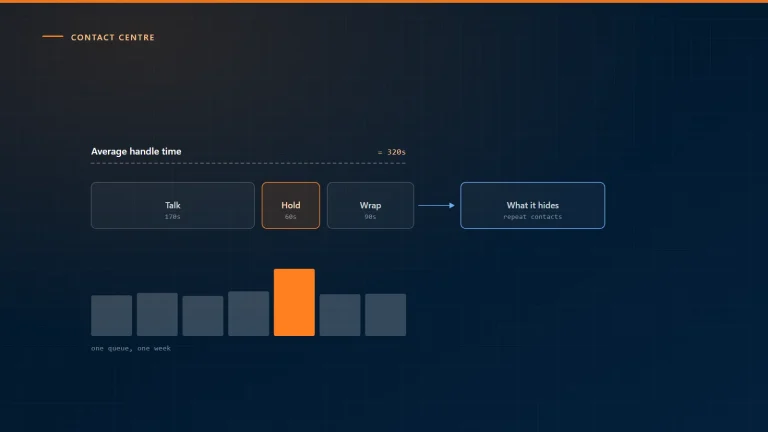
A large share of contact in public services is not a new request. It is someone asking what happened to the request they already made. That volume is almost entirely avoidable, and it is avoidable with status rather than with more staff.
A case reference, a current state, and a proactive message when the state changes will remove more calls than any menu redesign. It also requires the back-office system to have a state worth reporting, which is frequently the real gap.
What constrains the technology choices
- Records are public records.Correspondence is retained under a schedule, and that schedule drives storage design rather than the other way round.
- Procurement outlives the technology.Anything chosen has to be operable by whoever holds the contract in five years, which argues for standard platforms and against bespoke.
- Accessibility is an obligation, not a feature.Designing for it late costs several times what designing for it early does.
A reasonable order of work
Instrument the phone line before redesigning it: call volumes by reason, abandonment by menu position, and how many calls are status chasing. That data usually reorders the roadmap on its own, and it is cheap to collect.
We build IVR systems and contact center platforms, and run the infrastructure behind them. Tell us what your call mix looks like and we can say what the menu should.