Average handle time tells you less than you think
Average handle time is the first number most contact centers put on a wallboard, and it is the one most likely to be read as a score. It is not a score. It is a duration, and a duration only becomes meaningful next to the outcome it bought.
What the number is made of
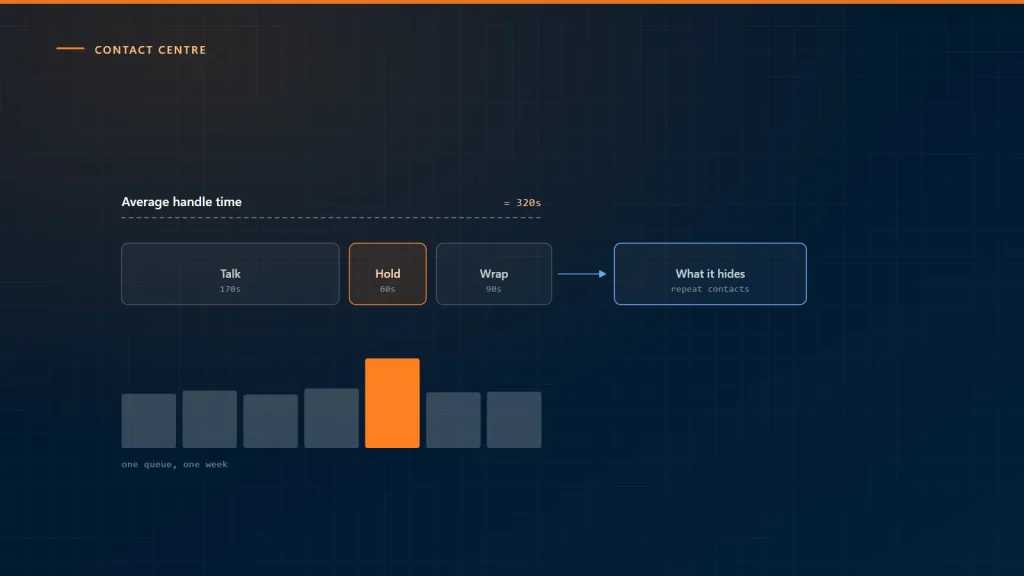
AHT is three things added together: talk time, hold time, and after-call work. They behave differently and they are worth separating before anyone tries to improve the total.
- Talk time.The conversation. Mostly set by how complicated the request is, not by how quickly the agent speaks.
- Hold time.The agent looking for something. The clearest signal of the three, because it almost always points at a system, a permission or a document rather than at a person.
- After-call work.The agent writing down what happened. The part that quietly absorbs every new field someone adds to a form.
A center that reports one blended figure cannot tell which of those moved. A center that reports all three can usually name the cause within an afternoon.
Why the total is easy to move the wrong way
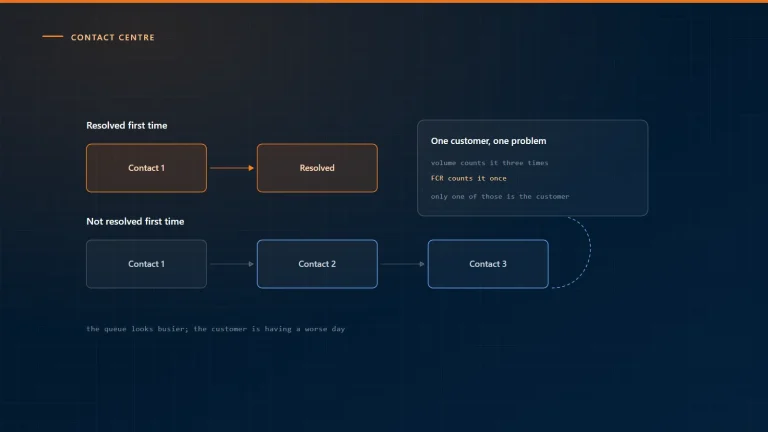
Handle time responds immediately to pressure, and it responds by pushing work somewhere else. An agent who ends a call ninety seconds sooner has not necessarily resolved it ninety seconds sooner — the customer may simply call back tomorrow, where the second contact is counted as new volume rather than as the same problem.
This is why a falling AHT beside a rising contact rate is not an improvement. It is the same work, counted twice, at a worse experience.
The three numbers to read beside it
First contact resolution
The proportion of contacts that did not need a follow-up. Read together, AHT and FCR say something AHT alone cannot: whether time spent is buying resolution or deferring it.
Contact rate per customer
How many times the same account reaches you in a period. It catches the repeat contacts that FCR can miss when the customer gives up and tries a different channel instead of calling back.
The distribution, not the mean
An average hides its own tails. A queue averaging 320 seconds might be tightly clustered, or it might be a mass of 200-second calls and a long tail of 900-second ones. Those are different problems and they have different fixes. Look at the median and the 90th percentile before drawing any conclusion from the mean.
When a longer call is the right answer
Some contacts should take longer. A complaint, a vulnerable customer, a cancellation you would rather not have, an account with a security question on it — these are the calls where the extra four minutes is the cheapest thing in the interaction. A blanket target applied across every queue makes those calls the ones agents feel worst about handling properly.
Segmenting the target by queue is usually enough. Sales, retention, technical support and billing do not share a natural duration, and pretending they do produces a number that is wrong for all four.
Making the parts visible
Most of the practical wins in handle time are not coaching, they are plumbing:
- Screen-popping the account on answer removes the first thirty seconds of nearly every call.
- Giving agents read access to the system they currently have to ask someone else about removes most hold time.
- Cutting one unused field from the wrap-up form removes a few seconds from every contact, permanently.
- Letting the agent finish notes while the next call rings — or explicitly not letting them — is a decision, and it should be made deliberately rather than by default.
What to do with it
Report handle time split into its three parts, per queue, with a median and a 90th percentile beside the mean. Put first contact resolution next to it on the same view. Then treat a change in the total as a question rather than a result — something moved, and the split will usually tell you what.
Our call center solutions report these as separate series rather than a single blended figure, because a number you cannot decompose is a number you cannot act on. If you would like to see how a queue of yours decomposes, ask for a walkthrough.