Call recording: what to keep, for how long, and why
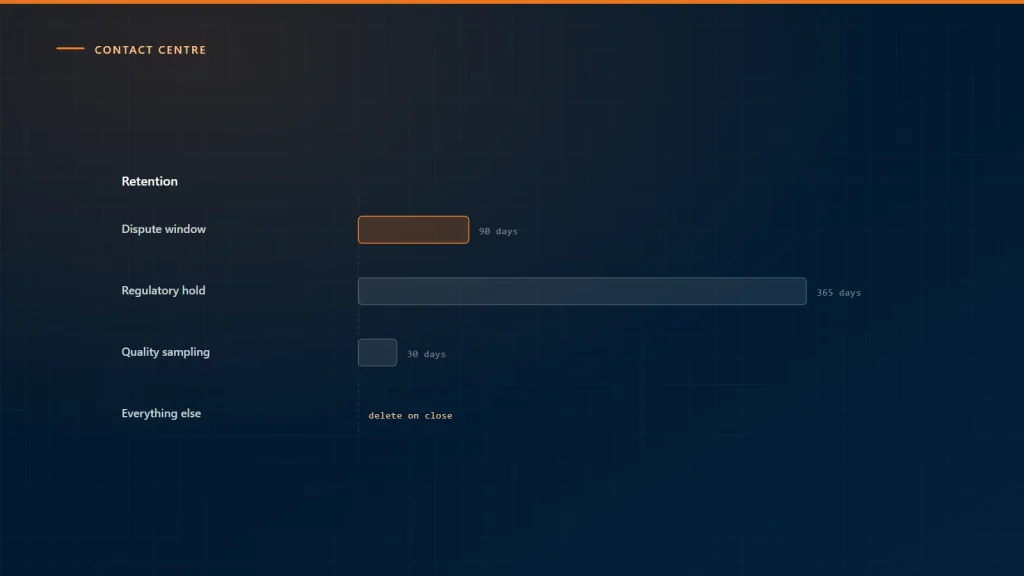
Most contact centers record every call and keep the recordings indefinitely, not because anyone decided to but because nobody decided not to. It is worth treating retention as a decision, because the default is expensive to store, awkward to search, and difficult to justify if anyone ever asks why you still hold a sales call from four years ago.
Start from why you are keeping it
There are only a few real reasons to hold a recording, and each implies a different period.
- Dispute resolution.The customer says one thing, the notes say another. In practice disputes surface within weeks, not years.
- Regulatory obligation.Where it applies it is specific, it is written down, and it overrides everything else here.
- Quality and coaching.A sample, reviewed soon after the call. A recording nobody has listened to in a month will not be listened to.
- Training material.A small, curated set, kept deliberately and with consent understood.
Notice that only one of those reasons benefits from a long period, and it is the one that is externally specified.
Different calls, different rules
A single retention period across every queue is simple and almost always wrong — too short for the regulated calls and far too long for everything else. Segmenting by queue is usually enough granularity:
- Regulated transactions: whatever the obligation says, and no longer.
- Billing and account changes: long enough to cover the dispute window, typically months rather than years.
- General enquiries: short. These are the bulk of the volume and almost none of the value.
- Curated coaching examples: kept separately, with their own justification.
The parts people forget
Payment details
If card details are ever spoken, a recording that captures them becomes a much more sensitive asset. Pause-and-resume — automatic, driven by the agent’s screen rather than by the agent remembering — is the usual answer, and it should be verified rather than assumed to be working.
Screen recording
Where screens are captured alongside audio, the recording contains everything visible, including data belonging to other customers. It deserves a shorter period and tighter access than the audio.
Transcripts
A transcript is far smaller than the audio and far easier to search, which makes it tempting to keep longer. It is still the content of the call. If the audio has been deleted on a schedule, a transcript retained indefinitely quietly undoes that decision.
Access is half the control
Retention answers how long. Access answers who, and it matters at least as much:
- Playback restricted by role, not shared as a folder.
- Every playback logged, including by supervisors and administrators.
- Export treated as a separate and rarer permission than playback.
- Deletion automatic on schedule, so it does not depend on someone remembering.
Make deletion the default path
The practical test of a retention policy is whether anything has ever actually been deleted by it. A policy that says ninety days, on a system where nothing has been removed since it was installed, is not a policy. Check the oldest recording in the store against the policy; if they disagree, the schedule is not running.
A workable starting shape
- List the queues and name the reason each one is recorded for.
- Set a period per reason, with the regulated ones taken from the obligation and the rest set as short as the dispute window allows.
- Turn on automatic deletion, then verify it a month later by looking for the oldest file.
- Log access and review the log occasionally — it is the part that catches problems no policy predicts.
Our call center solutions apply retention per queue rather than per platform, and log playback as an event rather than leaving recordings as files on a share. If retention is currently “everything, forever”, that is a short conversation worth having.