Driving Innovation in the Banking and Finance Industry

Banks and NBFCs run more core systems than almost any other kind of business, and most of them were bought at different times for different reasons. The interesting technology question in this sector is rarely which platform to adopt next. It is how the ones already running talk to each other, and what happens when one of them is down.
The integration problem is the real problem
A retail lender typically runs a core banking system, a loan origination system, a collections platform, a KYC service, a credit bureau connection, a payments gateway and a customer communication stack. Each was selected on its own merits. None was selected for how well it joins the others.
The symptoms are recognizable: a customer’s address updated in one system and stale in three, an agent reading a balance that is a day old, a reconciliation that takes two people a week every month. None of these is a platform failure. They are integration failures, and they are where most of the operational cost in a mid-sized lender actually sits.
What helps is unglamorous — one system designated as the owner of each fact, an event rather than a nightly batch where the delay matters, and a written map of which system tells which other system about what. Most institutions have never drawn that map, which is why nobody can say with confidence where a wrong address came from.
Collections is an arithmetic problem before it is a people problem
Recovery teams are usually measured on amount collected, which is the right outcome and a poor operating metric. The controllable numbers sit underneath it:
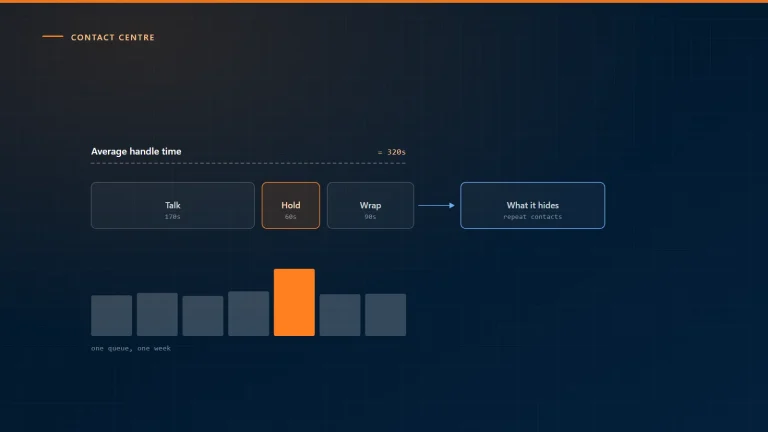
- Contact rate.What proportion of attempts reach the customer at all. Usually the largest single lever, and usually the least examined.
- Right-party contact.Reaching the borrower rather than a relative or a dead number.
- Promise-to-pay conversion.How many commitments become payments.
- Cost per rupee recovered, split by bucket. Early buckets and late buckets have completely different economics and averaging them hides both.
A collections operation that reports only the total cannot tell whether a bad month was fewer attempts, worse numbers, or weaker conversion — three problems with three different answers.
What regulation actually constrains
Financial services carry obligations that shape the architecture rather than sitting beside it: where data may physically reside, how long records must be kept, who may see what, and what must be provable after the fact. The last one is the one that surprises teams. It is not enough for access control to be correct; it has to be demonstrable months later, which means the logs are part of the system rather than a by-product of it.
Designing for that from the start is considerably cheaper than retrofitting it during an audit.
Where to start
Draw the integration map. Name the owner of each fact. Instrument the four collections numbers separately. Decide what has to be provable and check that it currently is. None of that requires a platform decision, and all of it makes the next platform decision better.
We build and run contact center platforms and managed infrastructure for lenders and recovery operations. If your reconciliation takes a week every month, that is usually an integration question worth a conversation.