Blended agents: when one team should handle voice, chat and email
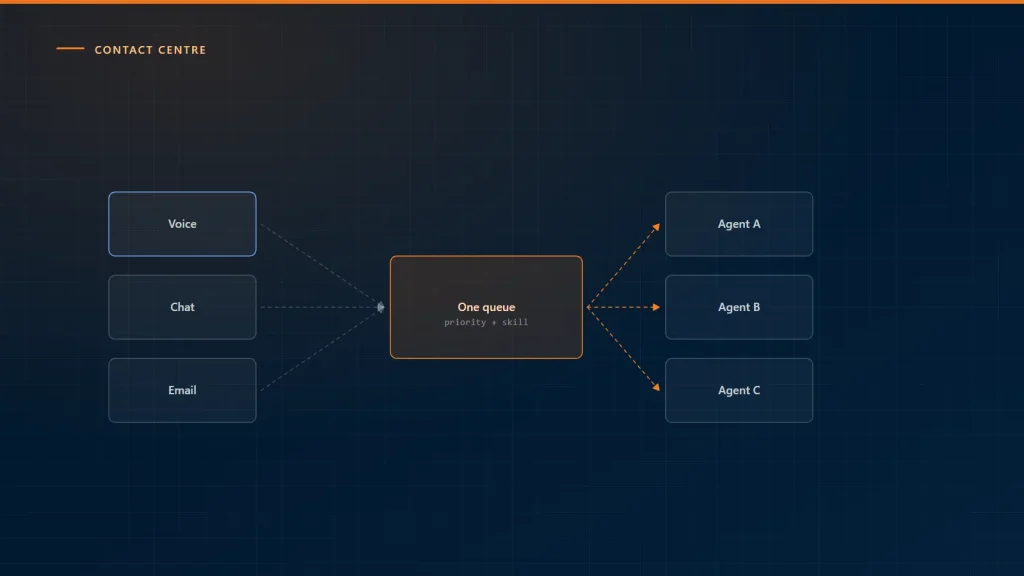
Running separate teams for voice, chat and email means three rotas, three queues and three sets of idle time that cannot help each other. Blending them into one team with one queue is the obvious fix, and it works — under conditions that are worth checking before committing to it.
Why blending helps at all
The gain is not that agents work harder. It is that variance in three queues partially cancels out. A quiet half-hour on voice can absorb a busy one on email, where two separate teams would simply have one team idle and one behind. The smaller your queues, the larger this effect — which is why blending helps a twenty-seat center far more than a two-hundred-seat one.
The conditions that make it work
The channels are about the same things
If voice is technical support and email is invoicing, the agent needs two bodies of knowledge and two systems, and blending mostly produces slower answers on both. Blend channels that carry the same work, not channels that happen to be in the same department.
The synchronous channel has priority, and it is explicit
A caller is waiting; an email sender is not. The routing rules must reflect that, which means an email in progress has to be interruptible or an agent has to be taken out of the voice pool while handling one. Both are valid — but the choice needs making, because the default is usually “whatever the platform does”, and that is rarely what anyone intended.
Concurrency is set per channel
One voice call at a time. Two or three chats, depending on how much typing the work involves. Email handled in blocks rather than interleaved. A single concurrency number applied across all three produces either idle agents or terrible chat response times.
Agents actually want to
Channel switching has a real cognitive cost, and it is not evenly distributed — some agents are much better at it than others. Blending everyone by default tends to show up in attrition among the people who are worst suited to it. A skills-based approach where some agents are blended and some are not is usually more stable than a uniform policy.
What breaks when the conditions are not met
- Chat response times collapse first.Chat is the channel with the tightest expectation and the least protection, so it absorbs the pressure from the other two.
- Email ages invisibly.Without an explicit reserve of time, email is always the thing that can wait, until it is four days old.
- Wrap-up work disappears.An agent moving straight from a call into a waiting chat does not write up the call, and the notes degrade across the whole center.
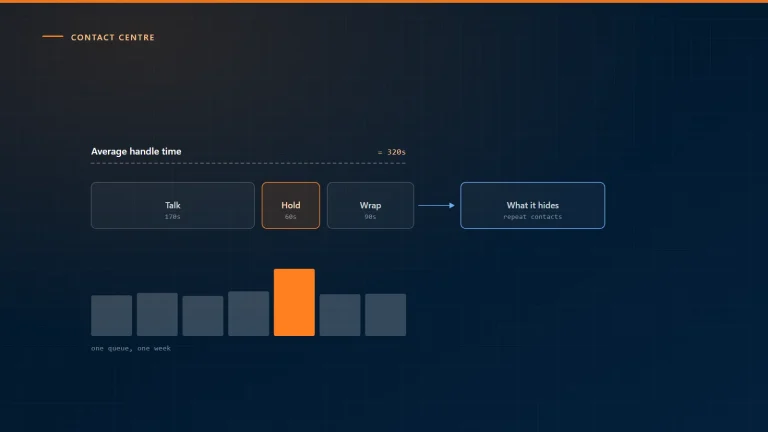
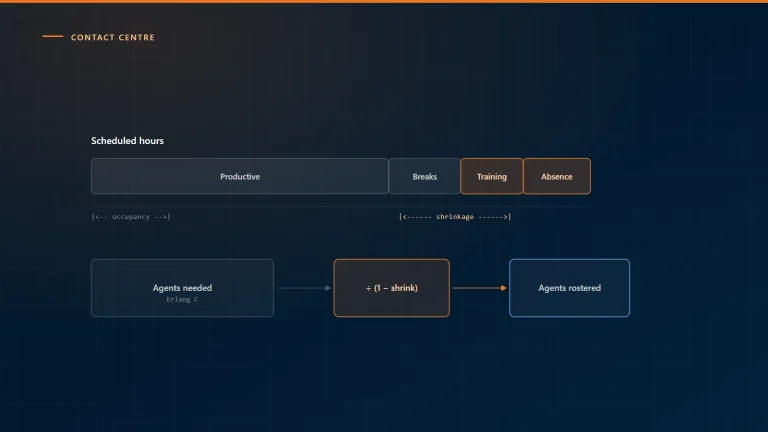
- Reporting stops making sense.Handle time, occupancy and adherence all assume one unit of work at a time. Blended, they need redefining, and if they are not redefined they will be quietly wrong.
Reserve capacity rather than hoping
The most reliable blending setups do not rely on the routing engine balancing perfectly. They reserve: a minimum number of agents held for voice at all times, and a defined block of the day where email is worked and voice is not. It looks less elegant than pure dynamic routing and it survives a bad Monday much better.
Measuring a blended team
Per-channel service levels still matter, and they should be reported separately even though the team is one. The additional number worth watching is switches per agent per hour — if it climbs, the routing is thrashing, and handle times on every channel will follow it up.
A reasonable way in
Blend two channels before three. Start with voice and chat, since they share the same urgency and usually the same knowledge. Keep email on a reserved block. Run it for a month with per-channel service levels visible, then decide whether the third channel joins.
Our call center solutions route by skill and priority across channels with per-channel concurrency, and report service level per channel rather than blending it into one figure — because a blended service level is the one number that can hide a channel failing completely.