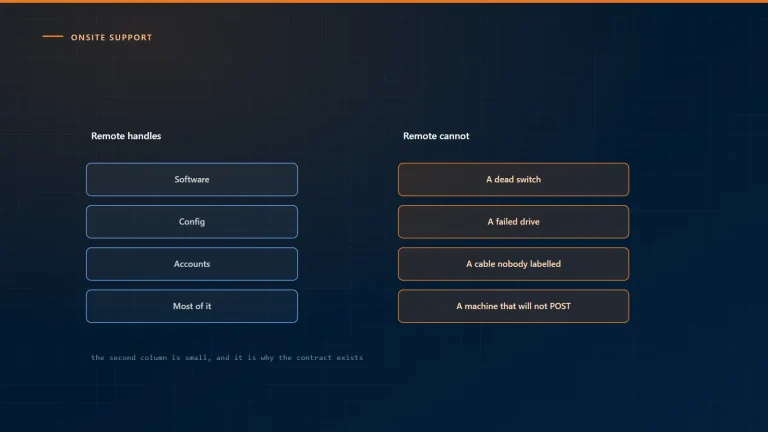
What spares to hold, and where
A spare is money spent to avoid waiting. Whether it is worth spending depends on how likely the failure is, how long the replacement takes to obtain, and what the wait costs — and those three vary enough that a blanket policy is always wrong in one direction.
The decision, stated plainly
Hold a spare where the cost of waiting exceeds the cost of holding. Downtime cost is the part organizations consistently underestimate: a warehouse scanner is not a cheap handheld, it is a picking line; a consulting laptop is a day of billable time per day of outage.
Work in those terms rather than in the purchase price and the answers change substantially.
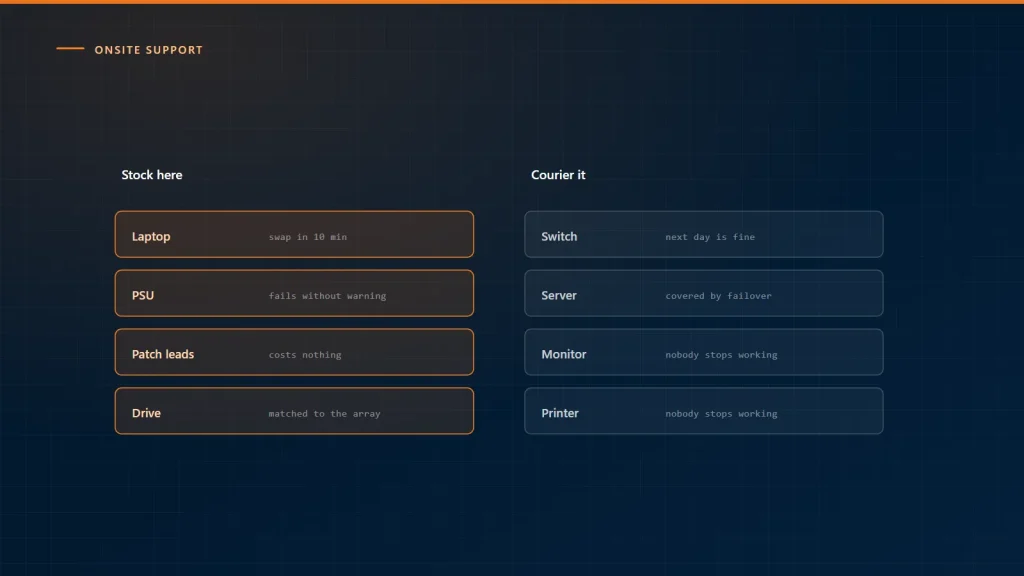
What is usually worth holding
- Complete user devices.The most valuable spare there is, because it converts every laptop fault into a fifteen-minute swap. One per twenty to fifty users, depending on how expensive downtime is, held imaged and ready rather than boxed.
- Power supplies and adapters.Cheap, fail constantly, and stop work completely.
- Drives, where they are not hot-swap and mirrored.
- Network patch leads, in quantity.Trivial cost, and their absence delays real work.
- A spare access point per site.Worth holding where wireless matters and lead times are long.
- An edge switch.For any site where a switch failure stops the whole site.
What is usually not
- Server components under a support contract.Where the response time has been tested, you are already paying for that cover.
- Anything with a short, reliable supply.If the wait is acceptable, so is not holding one.
- Expensive, rarely-failing items.The maths does not support it unless the downtime cost is extreme.
- Anything for a platform being retired.Common and quietly wasteful.
The one that gets forgotten
Consumables and accessories — docking stations, cables of the current standard, keyboards, mice, headsets, the adapter for whatever port the new laptops dropped. None of these are on a spares list because they are not assets, and they generate a steady stream of tickets that cannot be closed remotely.
Holding a modest stock of these at each site removes more visits than any single server component.
Where to hold it
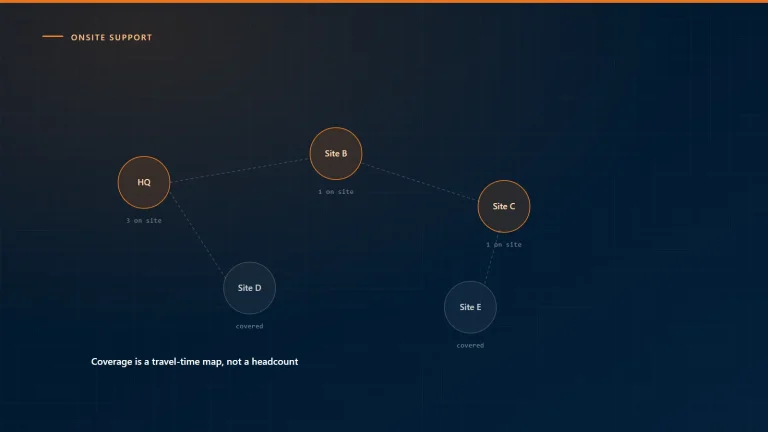
Central stock is efficient to manage and slow to reach a branch. Local stock is fast and hard to control. The usual sensible split:
- At each site: one or two user devices, adapters, cables, peripherals, and the site-critical network spare.
- Centrally: everything else, with a known overnight route to any site.
Local stock needs one named person responsible for it and a simple record of what was used, or it disappears — not through dishonesty, but because someone borrows the spare laptop for a visitor and it never comes back.
A spare is only a spare if it works
Several failure modes turn a spares cupboard into a cupboard:
- The spare laptop has not been powered on in a year and needs two hours of updates before it is usable.
- The spare switch has no configuration, and nobody has the config for the one it replaces.
- The spare has been used already and never replaced.
- It is locked in a room whose keyholder is on leave.
A quarterly check — power it on, confirm it is current, confirm it is present, confirm the configuration is available — is enough to prevent all four.
Standardization is what makes spares affordable
An estate with four laptop models needs four sets of spares. An estate with one needs one, and that spare covers everyone. Standardizing hardware is usually justified on procurement grounds; the support economics are the better argument, and they compound with every site.
Review it against what actually broke
Once a year, compare the spares list against the year’s actual failures. Items never used come off the list; items that ran out go up in quantity. Most spares lists are set once and never revisited, which is how they end up holding parts for equipment that left three years ago.
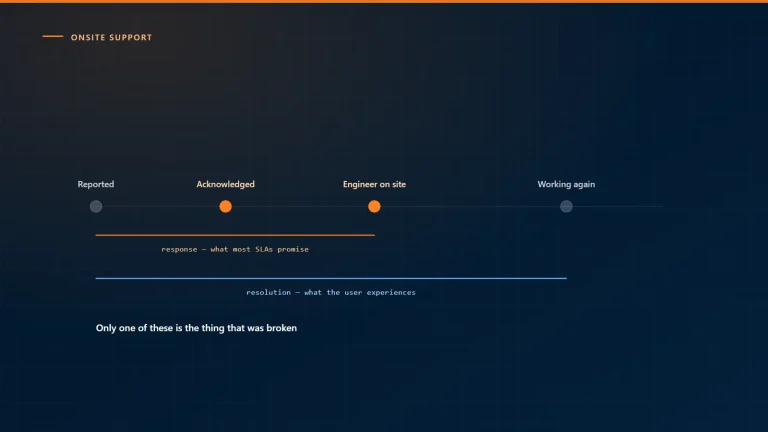
Our infrastructure managed services include the spares position as part of the estate review rather than as a procurement afterthought, because a support response time means very little if the part is a week away.