What happens to your phones when the internet goes down
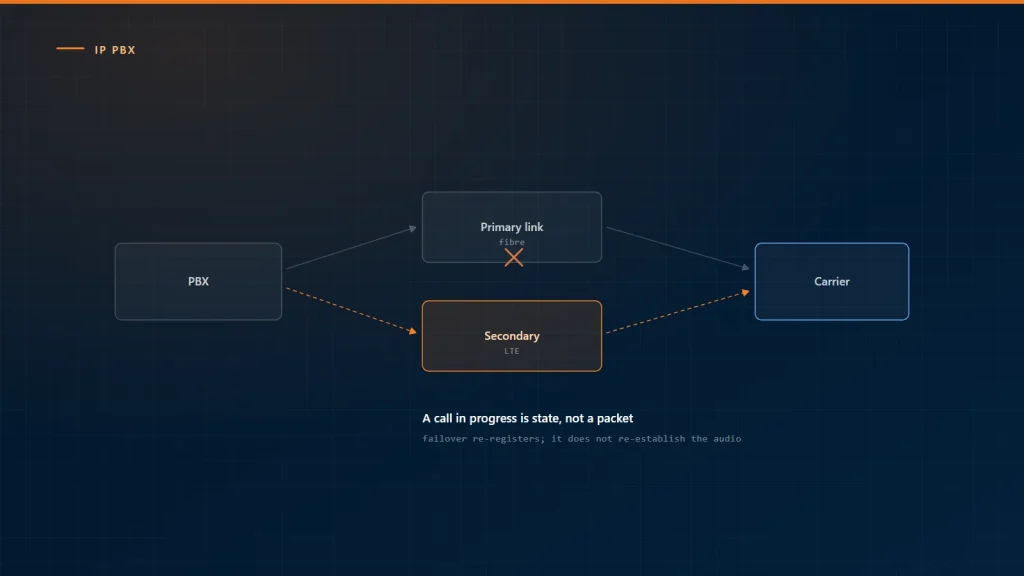
Ask what happens to the phones if the internet fails and the usual answer is “we have a second line”. That covers one failure out of several, and often not the most likely one. Worth going through them properly, because voice is the system people notice within a minute.
The failure modes, separately
The internet circuit fails
The most common and the best covered. A second circuit helps only if it is genuinely diverse — a different provider is not enough if both ride the same physical path into the building, which is more often the case than anyone expects. Ask for the route, not just the supplier name.
Power fails at the site
IP phones are powered by the switch. If the switch has no UPS, the phones are dead regardless of what the circuits are doing. This is the failure that most often defeats an otherwise good plan, and the fix — putting the access switches and the router on the UPS that already protects the servers — is usually cheap.
The PBX itself fails
Hardware, a failed update, a full disk. A second circuit does nothing here. This is what a standby instance or a hosted platform with its own redundancy covers.
The SIP provider fails
Rare, and completely outside your control. The only real protection is a second trunk from a different provider, with the numbers able to route to either.
A single site is unreachable but the rest is fine
The multi-site case, where head office is up and one branch is isolated. It needs a per-site answer rather than a central one.
What each layer of protection actually buys
- Second circuitCovers circuit failure only, and only if the path is diverse. Test the failover by pulling the primary, not by reading the configuration.
- 4G/5G backupGood for a branch, limited for a contact center. Check the concurrent-call capacity it can actually sustain, and prioritize voice on it, because it will be carrying everything else too.
- Provider-side diversionThe cheapest and most under-used. If the trunk does not respond, the carrier routes the main numbers to a mobile group. It does not preserve the queue, the IVR or the recording, but it means calls are answered by a person, which is most of what matters in the first hour.
- Standby PBXCovers platform failure. Only real if it has been failed over to deliberately at least once.
- UPS on the networkCovers the failure everything else assumes away.
Decide what “working” means during the outage
Full service restoration is expensive. Most organizations do not need it, and saying so out loud makes the design much cheaper.
Ask which of these is actually required while the main path is down: inbound calls answered by a person; the queue and IVR intact; outbound calling available; emergency calling available; call recording continuing. Emergency calling belongs on the essential list in every case. The rest are a judgment, and for most offices “a person answers, outbound works from mobiles” is a perfectly acceptable degraded state.
Test it, on purpose, on a schedule
An untested failover has an even chance of working. Twice a year, in a quiet hour, with notice:
- Pull the primary circuit physically and time how long until calls flow again.
- Confirm inbound, outbound and emergency all work in the failed state.
- Restore, and confirm it comes back cleanly — failback breaks at least as often as failover.
- Write down the time it took and what surprised you.
The surprises are the point. In practice they are usually a hard-coded IP address somewhere, a certificate that only the primary path presents, or a firewall rule that exists on one router and not the other.
Write it on one page
Who notices the outage and how, who declares it, what the degraded state is, what number customers are told, and who to call at the provider with the account reference. Kept somewhere reachable without the network — the whole point is that it is needed when the systems are not there.
AcmaPBX supports multiple trunks with failover routing and standby deployment, and our infrastructure managed services cover the testing schedule so the twice-a-year exercise actually happens rather than being the thing that slips.