Designing a dial plan you will not have to redo
Extension numbering is the part of a phone system that seems too simple to design, which is why so many organizations end up renumbering. A renumber means new stationery, new signatures, new directory entries and a month of misdialled calls — all avoidable at the point when the plan was drawn.
The decision that matters most: how many digits
Three digits gives 1,000 numbers and feels generous at fifty staff. It is not, because a dial plan is never filled evenly. Once ranges are reserved by department and by site, a three-digit plan is effectively exhausted at a few hundred extensions.
Four digits is the sensible default for almost everyone. Five is justified where there are many sites or a genuine expectation of tens of thousands of endpoints. Going up a digit later means renumbering everything; starting one digit wide costs nothing.
Reserve the first digit deliberately
The leading digit is the scarcest resource in the plan, and it gets consumed by things that are not extensions:
- An outside-line prefix.Commonly 9 or 0, where one is used at all, and it takes that digit out of extension use entirely.
- Emergency numbers.Nothing in the plan may shadow or delay them, and this constrains what the first digits can be.
- Service codesVoicemail, call pickup, park, paging, do-not-disturb. Give them their own leading digit rather than scattering them.
- Site prefixes.Where inter-site dialing is by prefix.
Map those first. What is left is the extension space, and it is always smaller than the raw digit count suggests.
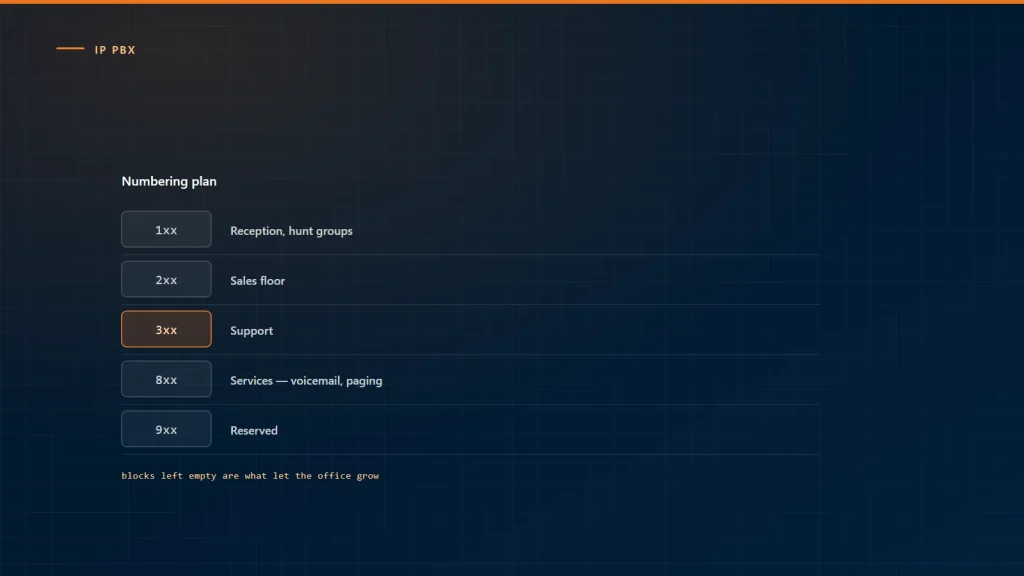
Structure by site, then by function
A block per site, then blocks within each site by department, is the arrangement that survives growth. It means a number tells you where a person is, which matters for routing, for emergency location and for reading a report.
Leave gaps. A department with twenty people gets a block of fifty. The instinct to pack numbers densely is the main cause of later renumbers, and unused numbers cost nothing.
Align extensions with DDIs where you can
If the DDI range ends in the same digits as the extension — 020 7946 0142 reaching extension 142 — then one fact serves both internal and external dialing. Directory entries, reception transfers and mobile contacts all get simpler.
This is not always possible, particularly with ported ranges from several carriers, but it is worth a lot when it is, and it is much easier to arrange at design time than afterwards.
The parts that are not people
Hunt groups, queues, conference rooms, meeting rooms, the warehouse handset, the door intercom, the fax. These need their own ranges, chosen so they are recognisable. A separate block for non-person endpoints prevents the common mess where a queue sits between two desks and nobody can tell from the number what will happen.
Short codes and the timing trap
If 4 is an extension prefix and 44 is a short code, the system must wait to see whether more digits are coming. That wait is a dead pause on every call starting with 4, and users experience it as the phone system being slow.
Design so that no valid code is a prefix of another valid code. It is a small constraint at design time and removes a whole class of complaint later.
Document it where people will find it
A dial plan that exists only in the PBX configuration will drift. One page — ranges, what each is reserved for, what is allocated and what is free — kept beside the rest of the system documentation is enough, and it is what makes the plan survive a change of administrator.
A checklist before you commit
- Four digits unless there is a specific reason for five.
- First-digit map drawn: outside line, emergency, service codes, sites.
- Blocks per site, then per department, with gaps of at least half again.
- DDI last digits aligned to extensions where the ranges allow.
- Separate ranges for groups, rooms and devices.
- No valid code is a prefix of another.
- One page of documentation, stored with the system, not on a desktop.
AcmaPBX supports multi-site prefixing and per-site routing, so a plan designed this way can be implemented as written rather than compromised to fit the platform. If you are standing up a new system or merging two, the numbering is the hour best spent before anything is configured.